
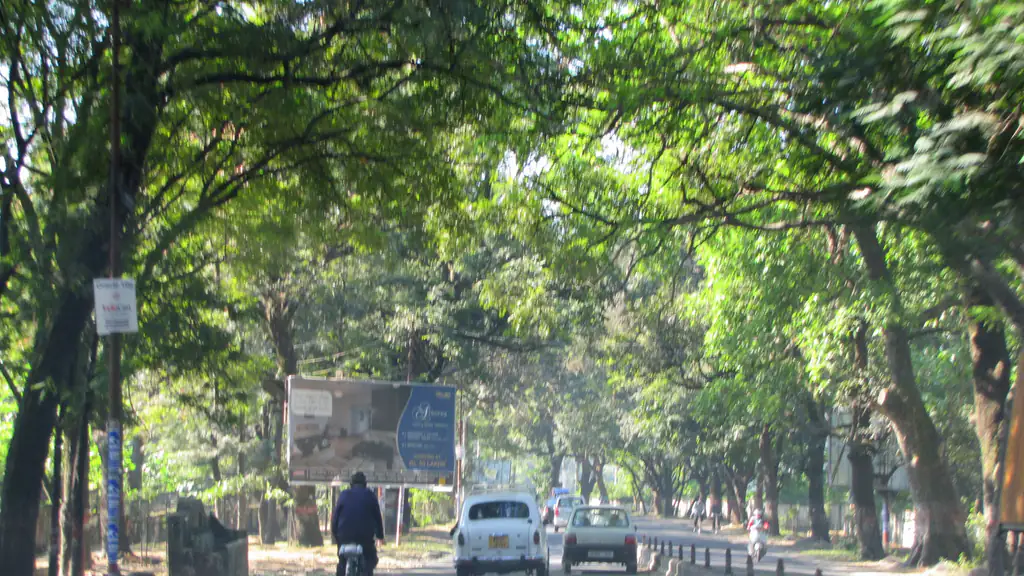
If you ask anyone in Dehradun where to go for coffee, a bookshop or an evening out, the answer usually starts with “Rajpur Road”. It begins at the Clock Tower and climbs gently north for roughly 10 km (our rounded map measure, November 2026) to old Rajpur, where the plains end and the hill road to Mussoorie begins. The bottom end is shops and traffic. The top end is quieter, greener and older than it looks. Most visitors only see the middle.
Rajpur Road: what we checked
- Weekend Mussoorie traffic
- In the weekend plan reported on 20 June 2026, Dehradun Police routed traffic returning from Mussoorie (towards Himachal, Rishikesh and Haridwar) down Old Rajpur Road and through the Sai Mandir diversion. A new plan is issued for each busy weekend and holiday, so check Dehradun Police on X on the day.PTI via Economic Times, 20 Jun 2026, checked 1 Nov 2026
- Storm closure, June 2026
- On the evening of Thursday 4 June 2026, rain brought down trees on Rajpur Road. The SP (traffic) said at least four fell at different points; vehicles were diverted towards Canal Road and the debris was cleared by night. Commuters reported jams from Jakhan to the Clock Tower.Times of India, 4 Jun 2026, checked 1 Nov 2026
- Astley Hall today
- Privately owned and in commercial use since the 1930s. In May 2023 the Times of India reported that upkeep around it had been neglected and that a Smart City revamp had been dropped; INTACH’s Uttarakhand convener called for the façade to be improved. We found no newer report.Times of India, 4 May 2023, checked 1 Nov 2026
- Rajpur–Jharipani bridle path
- About 5 km. The path was paved some years before 2021, and two-wheelers now use it; in January 2021 the tourism department proposed developing it as a trekking route.Times of India, 26 Jan 2021, checked 1 Nov 2026
A road older than the city around it
Rajpur came before Rajpur Road. Pradeep Singh, the local historian behind Bygone Doon, writes that the village was one of those granted revenue-free to Guru Ram Rai in 1676 by the Raja of Garhwal, the same Guru Ram Rai whose dera gave Dehradun its name. The 1911 district gazetteer still records the revenue village of Rajpur as belonging to the Guru Ram Rai temple.
What made Rajpur matter was Mussoorie. Once the British began building up the hill station from the 1820s, every traveller and trunk going up had to start somewhere, and Rajpur was the end of the cart road. The gazetteer describes it as a small town at about 3,000 feet, seven miles from Dehra and seven from Mussoorie, mostly a double row of houses on either side of a steep road. It grew out of three villages, Rajpur, Birgirwali and Dhakpatti, whose names survived as its mohallas. It was declared a town in 1867 and had 2,900 people in 1901, plus a large floating population of porters who carried luggage and dandies up the hill.
Two details in the gazetteer we like. The railway was first meant to run as far as Jakhan, halfway up to Rajpur, but Rajpur’s hotel-keepers petitioned against it and the line stopped at Dehra. By 1911 the gazetteer says this was “now admitted to have been a mistake”. And it says Rajpur was warmer than Dehra in winter and cooler in summer, so a few Mussoorie residents came down to spend the cold months there.
Rajpur’s boom ended with the motor road. Bygone Doon dates the decisive blow to 1930, when a motorable road to Mussoorie opened and the forwarding agencies and hotels that lived off overnight travellers closed. The same account mentions a small memorial near the Rajpur post office to 78 local men who died in the First World War.
The old Mussoorie bridle path
Before the motor road, there were two ways up from Rajpur. The gazetteer describes Mackinnon’s cart road, built in 1843 by a joint-stock company and about fourteen miles long, used mostly for brewery goods and liable to landslips in the rains. Foot travellers, riders, porters and pack animals took the shorter bridle path through Jharipani, and the gazetteer reckons a good pony did it in an hour and a half.
That path still exists. The Times of India described it in 2021 as about 5 km from Rajpur to Jharipani, little used since the motor road, and often called the Kipling trail because Rudyard Kipling travelled it in 1888 and drew on the trip in Kim. The same report said the path had been made pucca a few years earlier and that two-wheelers now use it, so expect the odd scooter. We’d only suggest it on a dry morning, with water, and starting early enough to be down well before dark. Skip it in the monsoon and for a day or two after heavy rain: this is a hillside path and slopes above it can slip. As of 1 November 2026, we could find no official notice from the tourism department or the district on the path’s condition, so check the IMD Dehradun forecast on the morning you go, and ask us.
Astley Hall
Astley Hall is the block of shops and eateries on lower Rajpur Road, near Gandhi Park, and for most Doonwallahs it is where Rajpur Road really starts. It was once a bungalow on a large estate. Kulbhushan Kain, writing in the Garhwal Post in April 2024, says it belonged to the Englishman known as “Pahari” Wilson, who made his life in Harsil on the Bhagirathi, and that Lady Dufferin, wife of the Viceroy, stayed there in March 1887 and described its long central room divided by a curtain. The Times of India reported in 2023 that the building was converted to commercial use in the 1930s and is privately owned.
Don’t come expecting a heritage site. Astley Hall today is busy, a little shabby, and full of the city going about its day. Go for the history you know is under it, a snack, and a look at the old façade between the signboards.
Cafés along Rajpur Road
We don’t name cafés on this site. They open, close and change hands quickly, and what we liked last month may be different by the time you read this. Instead, here is how the road sorts itself:
- Lower Rajpur Road, around Astley Hall and Gandhi Park. Old-style bakeries and sweet shops, quick-service restaurants and snack counters. Good for a mid-morning break on a walk from the Clock Tower.
- The middle stretch, past the malls towards Jakhan. Larger cafés with indoor seating, coffee roasters and bakeries, and the places people take a laptop to on a weekday afternoon. This is also where the evening traffic is worst.
- Upper Rajpur Road, towards the hills. Cafés with terraces and a view of the Mussoorie ridge. Sunset is the busy hour. The city lights below and the lights of Mussoorie above are the reason to come.
- Old Rajpur bazaar. Small tea shops and a few local eateries. Rajpur is home to a Tibetan community, with monasteries and a Tibetan school, so momos sit alongside plain dal-chawal.
Our advice: go upper Rajpur Road for a weekday sunset, not a weekend one, and leave before the Mussoorie traffic starts coming down. On a Saturday or Sunday evening, the road can take a long time in either direction.
Sai Darbar
Sai Darbar is a Shirdi Sai Baba temple on Rajpur Road, a short way below old Rajpur. For many families in Dehradun it is part of the weekly routine. Thursday is the day devotees keep for Sai Baba, so expect bigger crowds then. The junction outside is known as the Sai Mandir T-junction, and you will see it named in Dehradun Police traffic plans: in the December 2025 New Year plan, for example, traffic from Mussoorie towards the Clock Tower was to be diverted here towards IT Park if Rajpur Road jammed.
We have not found an official timetable for the temple. Travel listings give different hours, so we haven’t put any here. If you want to be there for an aarti, ask at the temple or message us and we’ll find out. Dress modestly and leave shoes at the stand.
How we’d spend a day on Rajpur Road
- Morning, old Rajpur. Start at the top while it’s cool and quiet. Walk up through the bazaar to where the old bridle path begins and go a short way up it for the view, or the whole way if you’ve planned for it.
- Late morning, Sai Darbar. It is on the way down. Skip a Thursday if you want it quieter.
- Afternoon, lower Rajpur Road. Astley Hall, then on to the Clock Tower and Paltan Bazaar. Our Old Dehradun heritage walk picks up from there.
- Sunset, back up the road. A terrace café on upper Rajpur Road, on a weekday if you can.
What we’d skip: driving the whole length of Rajpur Road on a Friday or Sunday evening, and the bridle path on a wet day. If you are heading on to Mussoorie, Rajpur Road is the way up, so check Dehradun Police on X for that weekend’s plan before you set off.
Working from Dehradun
A lot of people who come to work remotely from Dehradun end up on Rajpur Road at some point: a change of desk on a weekday afternoon, a meeting over coffee, a walk to clear your head. Our home has fast Wi-Fi, a desk, a full kitchen and a courtyard that catches the morning sun, so you only need the cafés when you want them. Our long stays page explains how a longer booking works, and you can see the rooms and check your dates. We meet guests at the gate and live ten minutes away if anything comes up.
Sources: Dehra Dun district gazetteer, 1911 (Internet Archive); Pradeep Singh, Bygone Doon, 15 November 2021; Kulbhushan Kain, Garhwal Post, 14 April 2024; Times of India, 4 May 2023; Times of India, 26 January 2021; Times of India, 4 June 2026; PTI via Economic Times, 20 June 2026; Hindustan Times, 25 December 2025; Travel in Devbhoomi, 1 May 2025 (Tibetan community in Rajpur). All checked 1 November 2026.