Our Instagram bio says “Step into the slow, nostalgic charm of Old Dehradun”. This is the part of the city we mean. It is not a museum district. It is a working old town, loud and crowded in places, and most of what makes it worth a day is the history under the traffic. Three of the four stops sit close together in the old city and can be done on foot. The fourth, Khalanga, is out on the Sahastradhara Road side of the city and needs a car or an auto.
Old Dehradun: dates and timings
- Clock Tower (Ghanta Ghar)
- Foundation stone laid by Sarojini Naidu in 1948; inaugurated in 1953. Uttarakhand Tourism says Lal Bahadur Shastri inaugurated it; a 2024 Curly Tales report credits Sarojini Naidu with the 1953 opening too. We go by Uttarakhand Tourism.Uttarakhand Tourism (official page), checked 1 Nov 2026
- Darbar Sahib founded
- 1676, when Guru Ram Rai, eldest son of the seventh Sikh Guru, Har Rai, set up his dera (camp) in the valley. The name Dehradun comes from it.Times of India, 31 Mar 2024, checked 1 Nov 2026
- Jhanda Mela at Darbar Sahib
- Held every year on the fifth day after Holi, starting with a new flag on the flagstaff. Holi falls on Monday 22 March 2027, so the 2027 mela is expected around 27 March 2027, not yet announced.District Dehradun: Fairs & Festivals, checked 1 Nov 2026
- Khalanga War Memorial timings
- 9:00 am to 5:00 pm, as listed by Incredible India. The memorial is under the Archaeological Survey of India.Incredible India: Khalanga War Memorial, checked 1 Nov 2026
- Khalanga Mela
- Held every November at the memorial. Past editions reported by the Times of India were on a Sunday in late November (26 Nov 2017, 24 Nov 2019). The 2026 mela is expected around late November 2026, not yet announced.Incredible India; Times of India, 25 Nov 2019, checked 1 Nov 2026
Our walking order, and how long it takes
- Darbar Sahib first, in the morning, while the lanes around it are still quiet.
- The Clock Tower, a short walk away through the old bazaars.
- Paltan Bazaar, right by the tower. Browse, then eat lunch here.
- Khalanga War Memorial in the afternoon, by car or auto. The listed hours end at 5 pm, so in winter we’d leave the city centre by about 3 pm.
Allow a full morning for the first three and the rest of the afternoon for Khalanga. Wear shoes you can walk in all day and leave shoes off easily at Darbar Sahib. The old city’s pavements are narrow and busy, so keep children close and bags in front of you.
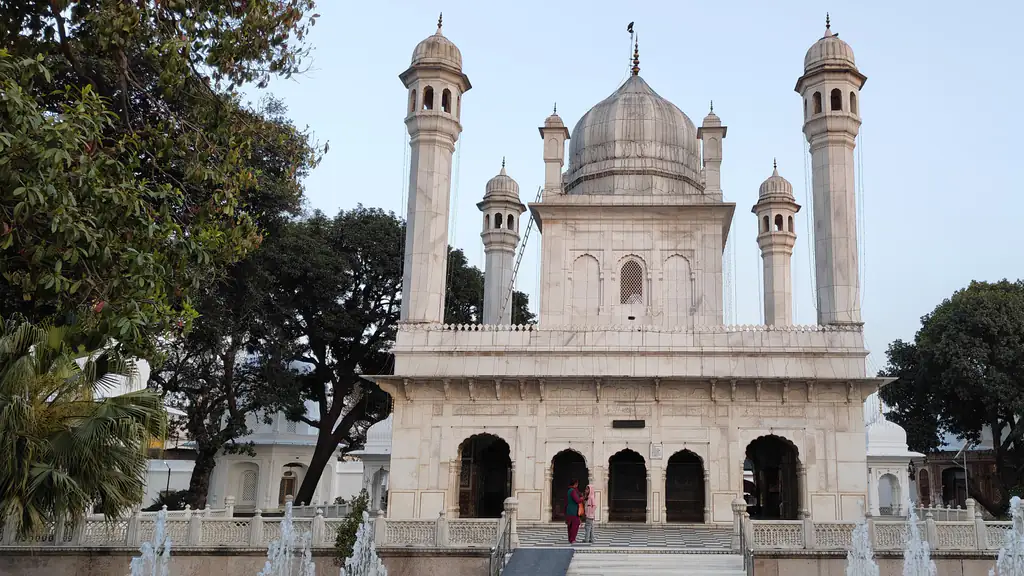
Darbar Sahib: where Dehradun got its name
The story of the city starts here. In 1676 Guru Ram Rai, the eldest son of the seventh Sikh Guru, Har Rai, set up a camp, a dera, in the Doon valley. The settlement came to be called Dehradun, and the flag he raised to mark his camp still stands at the centre of the Darbar Sahib, as the Times of India reported in 2024. That year the flagpole was 90 feet high.
If your trip falls around Holi, you’ll see the Darbar at its fullest. The Jhanda Mela starts five days after Holi, when the old flag comes down and a new one goes up. In 2025 the festival’s city procession passed Saharanpur Chowk and the Clock Tower, which tells you how close these places are. Expect very large crowds that week; on an ordinary morning the Darbar is far calmer.
It is a place of worship. Carry a scarf or cap to cover your head, expect to take off your shoes, and follow what the people at the gate ask. Behind the Darbar, near the Ramleela ground, is the Mataon ki samadhi, the tomb of four of the Guru’s wives. A 2015 Times of India report described its mix of Mughal, Sikh and Garhwali styles and bricks brought from Lahore, and also how neglected it was. We haven’t found a newer report on its condition, so treat it as a look from outside.
The Clock Tower (Ghanta Ghar)
The Ghanta Ghar is younger than it looks. According to Uttarakhand Tourism, it was built by a local landlord to mark India’s independence. Sarojini Naidu laid the foundation stone in 1948 and it was inaugurated in 1953. It has six faces, the first clocks came from Switzerland, and the names of freedom fighters were engraved on it. Incredible India’s page also gives 1953, though it says “during the British era”, which can’t be right for a tower started after 1947.
Today it is a busy roundabout more than a monument. You look at it from the edge of the traffic. In September 2024 Curly Tales, citing the Times of India, reported the clock had stopped after its mechanism was vandalised, the third such attack in recent years. The same report says the tower was commissioned by Lala Sher Singh in honour of his father, Balbir Singh. We haven’t found a later report on whether the clock was fixed, so don’t set your watch by it. Incredible India notes that the tower is lit up during festivals and celebrations, so if you’re in town for one, come back after dark.
Paltan Bazaar
Paltan Bazaar sits next to the Clock Tower. Incredible India calls it a wholesale market for basmati rice, and lists handicrafts, curios and antiques alongside, with chaat and chai stalls in between. If you want something to take home that is truly from here, a bag of Dehradun basmati travels well.
We can’t give you a reliable weekly closing day. Listings disagree about Sundays, and different lanes keep different hours, so don’t build your day around one particular shop. We’d walk it on a weekday morning.
What to eat on the way
We don’t name places, because they change and we’d rather you follow your nose. These are the things to look for, all mentioned on Incredible India’s Dehradun food page, plus the chai its shopping page mentions:
- Chaat and golgappe, which Paltan Bazaar and the lanes near the Clock Tower are known for.
- Chhole poori or poori with aloo sabzi, which Incredible India calls an all-day food Dehradun is proud of.
- Momos from street-side stalls, good on a cold afternoon.
- Bal mithai, the brown fudge-like sweet coated in white sugar balls, to carry back.
- Chai from the bazaar stalls, many times over.
If you’d like a Pahadi meal without hunting for one, we serve Pahadi breakfast on request at the house: mandua roti, aloo and seasonal fruit, ₹350 per guest per morning. Tell us the night before.
Khalanga War Memorial: the 1814 battle
For about twenty years until 1815, the Dun was under Gorkha rule, and in April 1815 the British took Garhwal, according to the district’s own history page. The war that ended that rule began here. In 1814, in the Battle of Nalapani, the first battle of the Anglo-Nepalese War, a small Gorkha force of about 600 under Balbhadra Thapa held the Khalanga fort for about six weeks against a much larger British army, with little food or water. Sources differ on the British numbers: Incredible India gives 3,000 British soldiers; the Times of India gives 3,500 under Major General Robert Gillespie.
What makes Khalanga unusual is that the winners built a memorial to the side they defeated. Incredible India describes the newer memorial on the hill, and, downhill in Kalinga Park near Sahastradhara Road, the original pair of obelisks put up by the British: one for Gillespie and his men, one for Balbhadra Thapa and his.
Every November the Gorkha community holds the Khalanga Mela here, with khukuri dances, a parade and Gorkhali food. The Times of India lists bhutwa, sel roti and fini among the dishes in 2017 and 2019. If your dates line up, it is the best day of the year to see the memorial.
The newer memorial sits on a hill above Kalinga Park. In the monsoon, roads on the hills around Dehradun can be hit by landslides and closures, so check conditions on the day before you set out. See our guide to checking roads and weather. In winter the light goes early; plan to be back on the road well before dark.
The tea gardens: Dehradun’s lost industry
Before the cafés, Dehradun grew tea. A 2015 Times of India report quoted the tea-garden workers’ association saying the British began the plantations in the 1860s, and a manager of the tea company saying Dehradun tea was exported to Pakistan, Afghanistan and Russia until the 1970s. The same report says the decline began after 1940, and that the tea-garden land was sold to a developer in 2008. The report is from 2015, so check the news before you plan around any of the gardens. They are private land, not a stop on this walk. We mention them because the tea story is as much a part of old Dehradun as the bazaar.
What to pair it with, and what to skip
- FRI the day before or after. The Forest Research Institute is the city’s other heritage building and fills a morning by itself. Don’t try to do FRI and the old town on the same morning.
- Robber’s Cave on a dry day. It is outdoors too, and gives the children a break from bazaars. See our Robber’s Cave page first.
- Skip the evening rush. Do the walk in the morning and the drive in the afternoon, not the other way round. The Clock Tower roundabout is one of the city’s busiest junctions, and it is no fun on foot at rush hour.
We’re from Dehradun and we’ll happily tell you how we’d shape this day around your dates. Stay a night or two at Fyonli Nest, our two-bedroom home with a courtyard that catches the morning sun, and send us your plan on WhatsApp. As we say on Instagram, “We help our guests to experience the best of local places”.
One place we left out: Christ Church. We couldn’t find an official or press source for when it was built, so we’d rather not guess.
Sources: Uttarakhand Tourism on the Clock Tower; Incredible India: Clock Tower; Incredible India: Retail therapy in Dehradun; Incredible India: A culinary adventure in Dehradun; Incredible India: Khalanga War Memorial; District Dehradun: Fairs & Festivals; District Dehradun: History; Times of India, 31 March 2024; Times of India, 19 March 2025; Times of India, 2 July 2015; Times of India, 26 November 2017; Times of India, 25 November 2019; Curly Tales, 11 September 2024; Times of India, 4 December 2015. All checked 1 November 2026.